Loading...
Serving Post Falls, ID and surrounding areas. (208) 981-9130
Is your slope moving, eroding, or sending water toward your house every spring? We build retaining walls with the drainage and base depth Post Falls winters demand - structures that hold for decades, not just a few seasons.
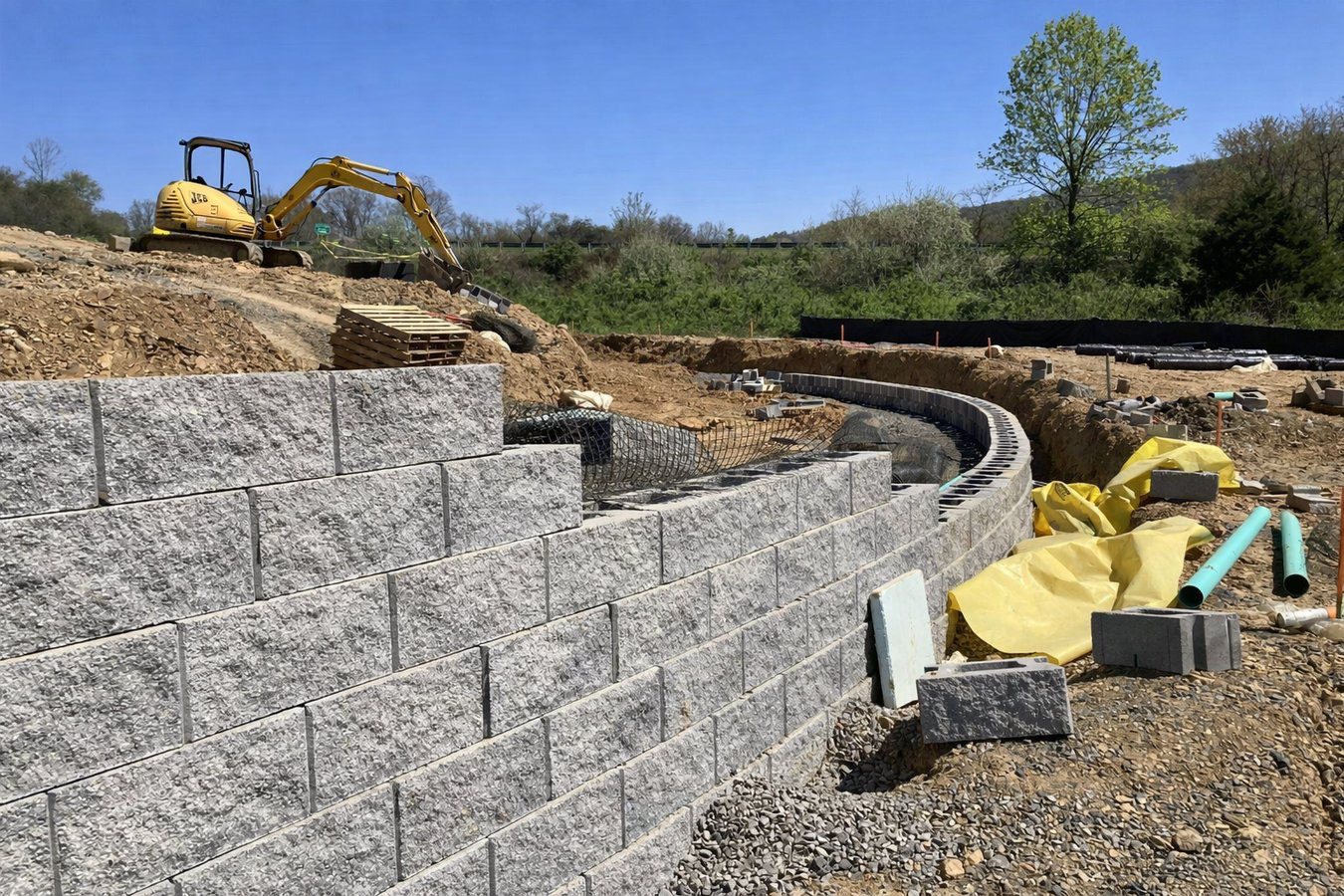
Retaining wall construction in Post Falls means building a structure - from concrete block, natural stone, or poured concrete - to hold back soil on a sloped or uneven yard, with most residential jobs completed in one to five days depending on wall height and length. A properly built wall includes a compacted gravel base buried below the frost line and a drainage layer behind the wall to prevent water pressure from building up and pushing the structure outward.
Many homeowners in Post Falls deal with slopes that erode after every rain or push soil toward a driveway, fence, or foundation. If the slope runs alongside your driveway, pairing retaining wall construction with driveway pavers is a common approach - both surfaces get a properly engineered base and drainage system in a single visit rather than two separate projects.
For properties where the underlying structure itself has shifted, our masonry restoration team can also repair or reinforce existing walls that are leaning or cracking before they reach the point of full replacement.
If you notice dirt, gravel, or mulch collecting at the bottom of a slope after a rainstorm or after spring snowmelt, your slope is actively eroding. Post Falls gets meaningful snowpack through winter, and the spring melt can move a surprising amount of soil quickly. Left alone, that erosion gets worse each year and can eventually undermine nearby structures or your foundation.
If the edge of a hillside looks like it is slowly moving - soil bulging outward, grass pulling away from the top, or cracks forming near the crest - the slope is losing stability. This is especially common on Post Falls properties built on graded fill soil, where the ground has not fully settled. A retaining wall stops that movement before it becomes a much larger and more expensive problem.
A retaining wall that leans noticeably when you stand back and look at it straight on is telling you it is under more pressure than it can handle. Horizontal cracks across the face of the wall, or gaps opening between the wall and the soil at the base, are signs the structure is failing. In Post Falls, walls built without adequate drainage often show these symptoms after several winters of freeze-thaw stress.
If water consistently collects against your home after a rainstorm, a sloped yard may be directing runoff toward the house instead of away from it. Over time, that moisture can work its way into your basement or crawl space and cause serious damage. A retaining wall combined with proper grading redirects that water away from your home.
We build new retaining walls from the ground up and replace walls that are failing. Every project includes excavating the base, setting a compacted gravel foundation, building the wall course by course, installing drainage behind the wall, and backfilling the area once construction is complete. For larger slopes or walls taller than four feet, we handle the City of Post Falls permit application and coordinate the required inspection - you do not navigate that process alone. When the finished wall creates a level terrace that you want to use as outdoor living space, we connect you with our masonry restoration team for any complementary stonework or paving on the new flat surface.
If your wall project also involves a raised planter, garden border, or property boundary, we build concrete block walls as standalone structures or as part of a larger landscape design. One contractor, one schedule, one point of contact.
Best for most Post Falls homeowners - durable, widely available in complementary styles, and well suited to the freeze-thaw stresses of Kootenai County winters.
Best for homeowners who want a traditional or rustic look that blends with an existing stone landscape or older-style home near downtown Post Falls.
Best for taller walls or slopes with high soil pressure - poured concrete offers maximum strength and is commonly specified when an engineer reviews the design.
Best for homeowners with an existing wall that is leaning or cracking but has not yet fully failed - repair is often less costly than full replacement if caught early.
Post Falls has grown fast over the last two decades, and many of the newer neighborhoods were built on land that was graded and reshaped during construction. Graded lots often have fill soil - ground that was moved and compacted during building - that behaves differently than undisturbed native soil and can shift more over time. When a slope made of fill soil starts to move, it moves faster and less predictably than a slope on native ground. The freeze-thaw cycle that Post Falls experiences every winter - temperatures dropping well below freezing and climbing back up again, sometimes multiple times in a single month - puts additional pressure on anything holding that soil in place. A wall built without a base deep enough to stay below the frost line will start to crack, lean, or heave within a few winters.
Post Falls also sits above the Rathdrum Prairie Aquifer, and soil moisture levels in some parts of the city - particularly lower elevations and areas near drainage channels - can be higher than homeowners expect. Higher soil moisture means more pressure on retaining walls after heavy rain or snowmelt, which is why drainage behind the wall is not optional - it is the difference between a wall that holds for 50 years and one that fails in five. Homeowners in Hayden and Rathdrum face the same soil and drainage conditions, and we build to the same standard across the whole service area.
We reply within one business day. We will ask about the size of the slope, what is happening now, and what you want to accomplish. Most retaining wall projects in Post Falls require an in-person visit before we can give you an accurate number.
We visit your property to measure the slope, assess soil conditions, and look at drainage patterns. We also check for underground utilities before any digging begins. You receive a written estimate breaking down materials, labor, and any permit costs.
Walls over four feet tall in Post Falls typically require a building permit. We submit the application to the City of Post Falls Community Development Department and coordinate the inspection. Permit review adds roughly one to two weeks, so we factor this into your project timeline from the start.
We excavate the base, build the wall one layer at a time, and install a drainage layer behind the wall to prevent water pressure from building up. Once complete, we backfill, grade the surrounding area, and walk the finished wall with you before we leave.
Free estimate. Written price. We handle the permit. Reply within one business day.
(208) 981-9130In northern Idaho, the frost depth can reach 18 to 24 inches in a hard winter. We set wall bases below that depth so the ground freezing around the footing cannot push the structure. Contractors who skip this step are building walls that look fine in October and start leaning by April.
We install a gravel drainage layer and, where needed, a perforated pipe behind every wall we build. Water pressure is the most common reason retaining walls fail - removing it is not an optional upgrade, it is standard practice on every job. Learn more from the University of Minnesota Extension.
Walls over four feet tall require a City of Post Falls building permit, and permitted work shows up on your property record - which matters when you sell. We submit the paperwork, schedule the inspection, and make sure the finished wall passes. You do not have to figure out the city process on your own.
Idaho law requires underground utilities to be marked before excavation begins. We coordinate with Dig Safely Idaho on every job so there are no accidental line strikes on your property. It is a step some contractors skip to save time - we never do.
Base depth, drainage, permits, and utility locating are not extras we charge for - they are what separates a wall that lasts from one that fails. Every job we take as a retaining wall contractor in Post Falls is built to the same standard, whether it is a short garden border or a full slope stabilization.
Repair leaning, cracking, or deteriorating masonry structures before full replacement becomes necessary.
Learn MoreBuild freestanding block walls for garden borders, property boundaries, or raised planting beds as part of a larger landscape project.
Learn MoreSpring crews book fast - contact us now and lock in your spot before the season fills up.